
There is a question that does not get asked enough in medical coding: why do some coders, after many years in the field, still struggle to stand out, while others with far fewer years behind them have already become among the best?
The answer is not years of experience. It is process.
Years do not automatically produce excellence. A coder who has worked ten years without a defined workflow is essentially repeating day one, ten thousand times. A coder who spends their first two years building and refining a streamlined process is compounding returns every single day they show up. One approach produces volume without growth. The other produces mastery.
My background is in Management Information Systems, and I bring that logic directly into my coding practice. That degree trained me to think in systems and design efficient workflows. Just like building software, you do not want clutter, redundancy, or unnecessary steps to reach a result. Every action should serve a clear purpose, and the path from start to finish should be as clean and direct as possible. There should be no wasted motion anywhere in the process. That same discipline applies to every record I touch.
Take day surgery coding as an example. From the moment you open an account to the moment you click finalize, every step is part of a process. The question every serious coder should ask is: what is the most accurate and efficient path from account open to account close?
Here is what that looks like in practice.
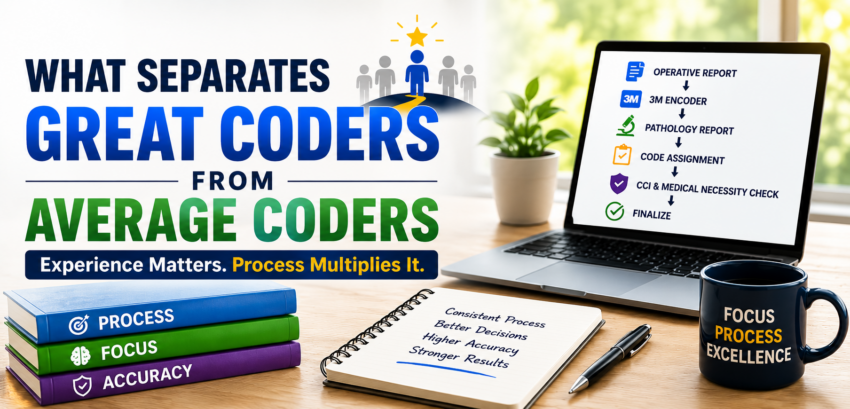
When you open the operative report, the system takes a few seconds to load. That is not dead time. That is the moment you open the 3M encoder in parallel, ready to assist with code assignment. Both run simultaneously. If the pathology report is available, it is open too, not as an afterthought, but as a primary reference. It tells you exactly what tissue or organ was biopsied or removed, confirms what the surgeon documented, and gives you a clearer picture of the final diagnosis before you commit to your codes.
After codes are assigned, you do not finalize without a final check. You review CPT codes and diagnoses against CCI edits and medical necessity, identify any unbundling issues or missing linkage between diagnosis and procedure, and correct any conflicts. Then you are done.
That sequence, repeated with full concentration every single time, is what separates the best coders from the average ones. The result is not just speed. It is accuracy at speed. You code more records at a higher quality level because your process is designed to catch errors before they leave your queue.
This is not a talent issue. It is a systems issue.
Build the best process you can. Refine it until every step is purposeful and nothing is wasted. Repeat it without shortcuts. The coders who become the best are not the ones who have seen the most records. They are the ones who designed the best system and committed to it, every single time.
Hoang Nguyen, BS, CCS, CCS-P, CIRCC, CCVTC