
I have been watching the news coming out of Silicon Valley, and I want to talk about what it means for us.
Meta cut 8,000 jobs. Oracle eliminated 30,000 positions in a single move. Amazon, Intuit, LinkedIn — the announcements kept coming. By the numbers, more than 148,000 tech workers have been laid off in 2026 so far. That is nearly 1,000 people per day.
Here is the part that should get your attention. These are not companies that are failing. Meta posted $56 billion in revenue in the first quarter of 2026 alone, up 33 percent year over year. These companies are profitable, growing, and still cutting. The reason they gave was direct: they need the money to fund artificial intelligence infrastructure. One internal memo said the layoffs were necessary to offset “the substantial investments we are making.”
They did not cut people because business was bad. They cut people because AI became cheaper than people for certain types of work.
If you work in health information management, revenue cycle, or medical coding, I want you to sit with that for a moment.
Because the same logic applies to us.
AI assisted coding tools are already deployed inside health systems across the country. They are handling high volume, routine encounters: standard E/M visits, straightforward diagnoses, repeat patients with predictable documentation patterns. Facilities are using these tools not just to help coders work faster, but to reduce the number of coders they need.
The coders most at risk are the ones whose daily work is defined almost entirely by volume. If your value to an organization is the number of charts you can move in a day, and a tool can move more charts faster with acceptable accuracy, that is a business decision that organizations will eventually make. Not because you are not talented. But because the math changes.
This is not a prediction about the distant future. It is happening now.
So what do we do?
The tech workers who survived this wave were not the ones who simply knew how to write code. They were the ones doing work that required judgment, oversight, and accountability. The architects. The reviewers. The people who could look at what the system produced and say whether it was right or wrong and why.
That same distinction exists in coding and HIM.
Clinical validation of AI generated codes requires a human who understands not just the codebook but the clinical picture behind the documentation. Physician query writing requires communication skill, clinical knowledge, and a working understanding of documentation standards that no tool currently has. Complex inpatient coding — sepsis sequencing, CC and MCC optimization, surgical procedures, complications — still demands trained judgment that AI tools do not consistently deliver with confidence.
Compliance auditing, quality review, and education are growing in importance precisely because every AI system deployed at scale creates new liability. Payers do not accept algorithmic error as a defense. The OIG does not care that the tool assigned the code. Someone with credentials and accountability still has to sign off.
If your organization is deploying AI coding tools, the human reviewer role is not disappearing. It is becoming more important, and more visible.
Here is what I want you to take away from all of this.
Move toward the work that requires judgment. Invest in your learning now, not later. Take the exam you have been putting off. Enroll in the training you keep saying you will get to eventually. Build skills in documentation improvement, complex case coding, auditing, and education. Pursue credentials that reflect depth and specialization. The CCS, CDIP, CIRCC, and similar advanced credentials do not just open doors. They tell an organization that you operate at a level that a tool cannot replace.
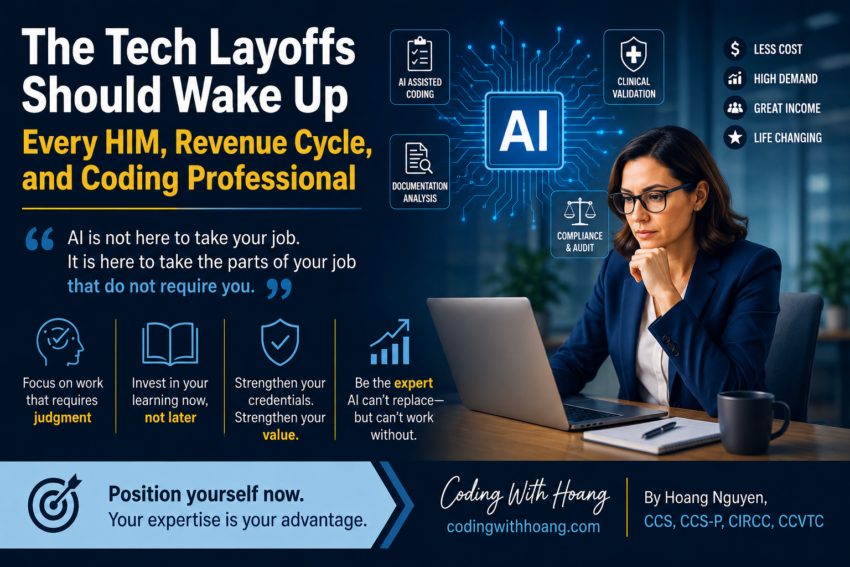
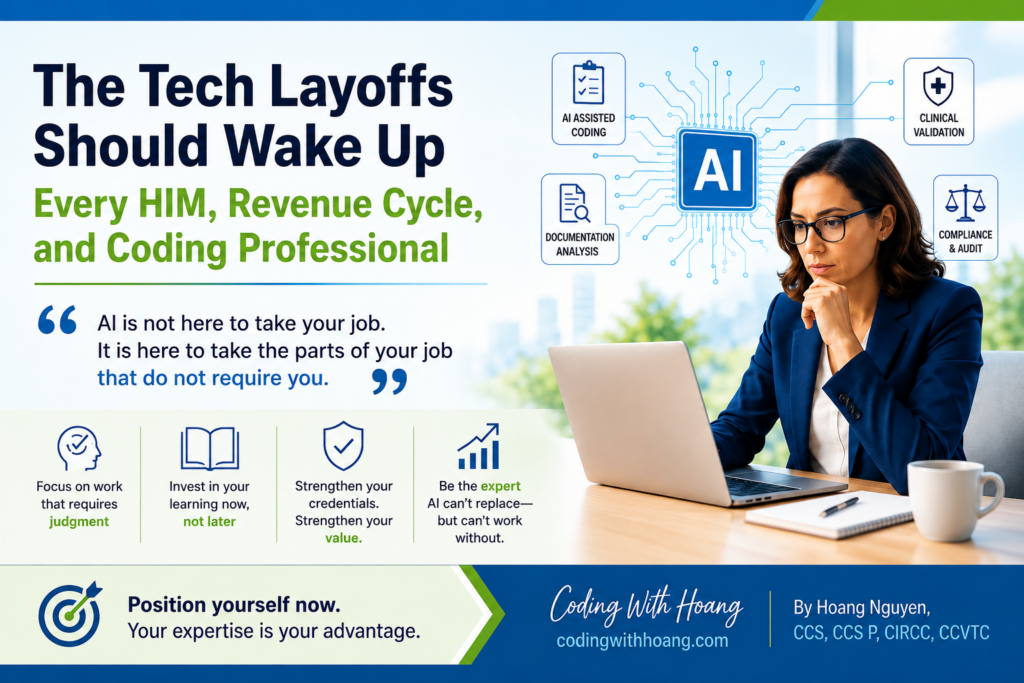
AI is not here to take your job. It is here to take the parts of your job that do not require you. The routine. The repetitive. The predictable. What is left — the judgment, the clinical reasoning, the compliance knowledge, the teaching — that is yours. But only if you invest in developing it.
The coders and HIM professionals who will thrive in this environment are not the ones who compete with AI. They are the ones who know more than AI, who can review what it produces, catch what it misses, and stand behind the work with their credentials and their name.
That is not working harder. That is working smarter. And it starts with a decision you make today, not when the pressure forces you to.
Position yourself now. Not because you should be afraid, but because you are worth more than what a tool can replace.
Thank you for reading. I wish every one of you success.
Hoang Nguyen, BC, CCS, CCS-P, CIRCC, CCVTC