
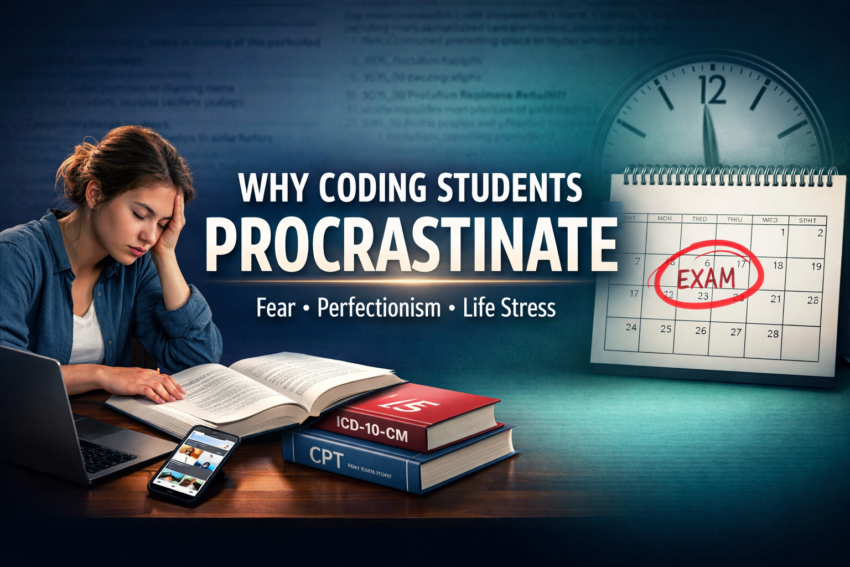
Procrastination is one of the most common struggles I see among medical coding students preparing for certification exams. It affects people studying for the CPC, CCS, CCA, CIC, and many other coding credentials.
What is interesting is that most of the students who experience this are not lazy, and they are certainly not lacking intelligence. Many are already working in healthcare. Some are even coding professionally. They genuinely want to pass the exam. Yet they find themselves delaying study sessions, avoiding practice exams, and telling themselves they will start tomorrow.
When we look deeper, procrastination in exam driven professions is rarely a simple time management problem. Research in health professions education shows that it is often connected to three powerful forces: fear of failure, perfectionism, and life stress.
The first and strongest driver is fear of failure. Many coding students carry a great deal of pressure when preparing for certification exams. Some are already working in the field and worry that failing the exam might reflect on their professional ability. Others have invested months of studying and do not want to face the disappointment of not passing. Because of this pressure, students often delay the very activities that would help them the most. Instead of taking a practice exam that might reveal weaknesses, they tell themselves they need to review just a little more first. Timed mock exams get postponed. Difficult guideline topics get pushed aside. What looks like procrastination on the surface is usually anxiety underneath.
The second factor is perfectionism. Medical coding naturally attracts detail oriented people, and accuracy is essential in our profession. That attention to detail is a strength. However, during exam preparation it can become a trap. Some students feel they must understand everything perfectly before they attempt practice questions. They hesitate to open a mock exam because they believe they are not fully ready. I hear this sentence very often from students: “I will take the practice test after I review one more chapter.” Then another chapter appears. Then another. What begins as preparation slowly turns into endless delay.
The third factor is life overload. Most coding students are adult learners. They work full time, manage family responsibilities, and often study late at night when their energy is already depleted. After a long day, the brain naturally looks for relief. Scrolling through a phone or watching a short video provides immediate comfort. Opening a difficult coding guideline chapter requires effort. In high stress environments, procrastination becomes a short term way to repair mood, even though it increases pressure later when the exam date approaches.
Over more than twenty years working in hospital coding and teaching new coders, I have seen this pattern many times. Students who are capable and motivated still struggle to begin because the pressure they feel becomes overwhelming.
In my experience, anxiety is usually what drives this cycle. Fear of failing the exam and the desire to be perfect slowly build pressure in the mind. When you add work responsibilities, family obligations, and daily stress, it becomes very easy to delay studying even when you truly want to move forward.
When I see students struggling with this, I do not tell them to simply work harder or become more disciplined. That rarely solves the problem. What usually helps is changing how they approach the study process.
My advice is to start small instead of waiting until you feel fully ready. Open a short set of practice questions. Review one section of the coding guidelines. Set a timer for thirty minutes and focus on just one topic. Taking a small step forward often reduces anxiety because you are no longer thinking about the work. You are doing the work.
I also remind my students not to treat practice exams as a test of perfection. The purpose of a practice exam is not to prove mastery. It is to reveal gaps. Every missed question is valuable feedback. It tells you exactly where to focus your next study session.
Finally, consistency is far more powerful than intensity. One focused hour of studying each day will build stronger knowledge than occasional long study sessions driven by pressure or guilt. Progress in coding, like most skills, comes from steady practice over time.
Over the years, I have seen many students who doubted themselves eventually succeed. The ones who pass are not always the most confident at the beginning. They are the ones who keep taking small steps even when they feel uncertain.
If you are currently preparing for a medical coding certification exam and struggling with procrastination, remember that the problem is rarely your ability. It is usually the weight of the pressure you are carrying.
Start small. Stay consistent. Progress builds confidence.
One step at a time. You can do it. I wish you all the best.
Hoang Nguyen, BS, CCS, CCS-P, CIRCC, CCVTC