
Why AI Will Replace You If You Only Code Simple Records
Over the years, I have thought a great deal about where medical coding is heading. This is not theory for me. I have worked in acute care hospitals for more than twenty years, and I hold a BS degree in Management Information Systems. I understand coding, and I understand how software logic works. When you combine those two perspectives, you start to see how predictable certain areas of coding really are, and how vulnerable that makes some coders right now.
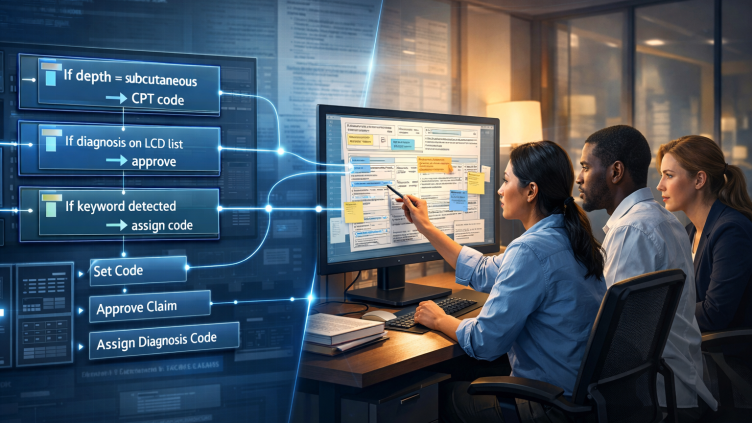
If I wanted to build a coding application for a wound clinic, the logic is not complicated. The payable diagnoses for wound care are largely defined by the LCD or LMRP. You preload those approved diagnoses into the system, and your diagnosis options are already narrowed to what is clinically and payer-appropriate. On the procedure side, the variables are limited. Debridement is selective or non-selective, sometimes excisional, sometimes not. The determining factors are technique and depth of tissue: epidermis, dermis, subcutaneous tissue, muscle, or bone.
A well-built application would scan the clinical note for those keywords, identify the technique, identify the tissue depth, cross-reference the anatomic site, apply ICD-10-CM sequencing rules, block invalid code combinations, and return the correct CPT and diagnosis pairing in seconds. Add LCD constraints as logic rules and the application is essentially complete.
A pain clinic follows the same principle. There is a defined set of injections, nerve blocks, radiofrequency ablations, and spinal procedures. Documentation patterns repeat. Keywords repeat. Coverage policies are structured. With clear logic and well-defined rules, much of that workflow can be automated.
This is not science fiction. This is basic structured logic. If someone like me, with coding experience and an MIS background, can outline this concept in a conversation, imagine what a dedicated AI development team can build with a full engineering budget behind them.
What does that mean for coders who only function at a task level?
If your role is limited to scanning documentation and matching patterns without deeper understanding, you are at risk. Non-technical, rule-based coding in narrow specialties can be automated. The system does not get tired. It does not call in sick. It does not need benefits or productivity benchmarks.
But here is the important part.
Complex cases cannot be reduced to keyword recognition alone. Clinical judgment, pathophysiology, documentation gap analysis, compliance risk identification, conflicting note interpretation, sequencing decisions that depend on the full clinical picture: these require a level of professional reasoning that automated tools cannot reliably replicate right now. AI can replace routine pattern recognition. It cannot easily replace strategic understanding and professional judgment.
So my message to coders is not to panic. It is to prepare.
Do not stay at the surface level. Learn guidelines deeply. Understand why sequencing matters, not just what the rule says. Study reimbursement methodology. Learn DRG validation, medical necessity standards, denial trends, and audit risk. Build the kind of expertise where you can review a system’s output and say, this is correct, or this is wrong, and here is exactly why.
Advance from code assigner to coding professional.
Technology will continue to evolve. Applications will become smarter. Automation will expand into more record types over time. That is reality, and pretending otherwise does not help anyone. But professionals who evolve with it, who understand both the coding and the logic behind the systems, will not be replaced. They will lead.
The application I described above could be built in a matter of weeks by a development team that knows what they are doing. Do not let your career be that easy to replace. This is the moment to step out of your comfort zone and learn the future. The coders who survive and thrive will be the ones who prepare early, think beyond routine tasks, and refuse to stay comfortable.
Thank you for reading and have a great day.
Hoang Nguyen, BS, CCS, CCS-P, CIRCC, CCVTC